This project seeks to document, elevate, and highlight evidence-based teaching practices that are known to improve student success and course completion rates at Indiana University and broadly in higher education. The goal is to advance a scholarly approach to teaching that values relationships, care, and evidence-based practice.
The “Culture of Care in Teaching” framework is built upon scholarship from higher education, educational psychology, feminist philosophy, and race and resistance studies. This IRB-approved research project includes a critical self-reflection survey of teaching practices for instructors, and an accompanying Canvas course that IU faculty can enroll in to delve deeper into the framework. More information about the framework is provided below in the Frequently Asked Questions.
Take the Culture of Care Survey
If you are an employee of IU, you can participate in the research study here.
Once you submit the survey, you will receive a copy of your responses to inform your ongoing professional development and growth as an instructor.
Student Success at IU Indianapolis
Indiana University’s 2030 Strategic Plan has outlined a “student success and opportunity” pillar to guide us in bringing on tomorrow. This pillar recognizes that student success is of paramount importance and undergirds how the university structures programs, designs curricula, and positions itself to respond to the evolving demands of today’s workforce. Indiana University educators are called to “ensure all students experience a welcoming and inclusive campus culture.” The plan further seeks to “foster cultural competency among faculty to build a more inclusive learning experience.”
In September 2024, IU Indianapolis Chancellor Latha Ramchand convened four work teams to advance student success efforts at IU Indianapolis. One of these teams, the Work Team for Course Completion, has been working to amplify the Culture of Care in Teaching project by securing IRB approval to disseminate the survey campus-wide and promote the framework actively at the unit level. During fall semester, the project was presented to faculty from the following schools, departments, and committees:
Department of English Faculty Meeting
Department of Psychology Faculty Meeting
DUE/UC Faculty Meeting
Indianapolis Faculty Council (IFC)
School of Liberal Arts Chairs Meeting
School of Liberal Arts Diversity Committee
School of Science Ambassadors
School of Science Faculty Assembly
School of Social Work Faculty Meeting
Undergraduate Affairs Committee (UAC)
If your department/unit is interested in learning more about this project, please contact the CTL at iuictl@iu.edu.
Frequently Asked Questions
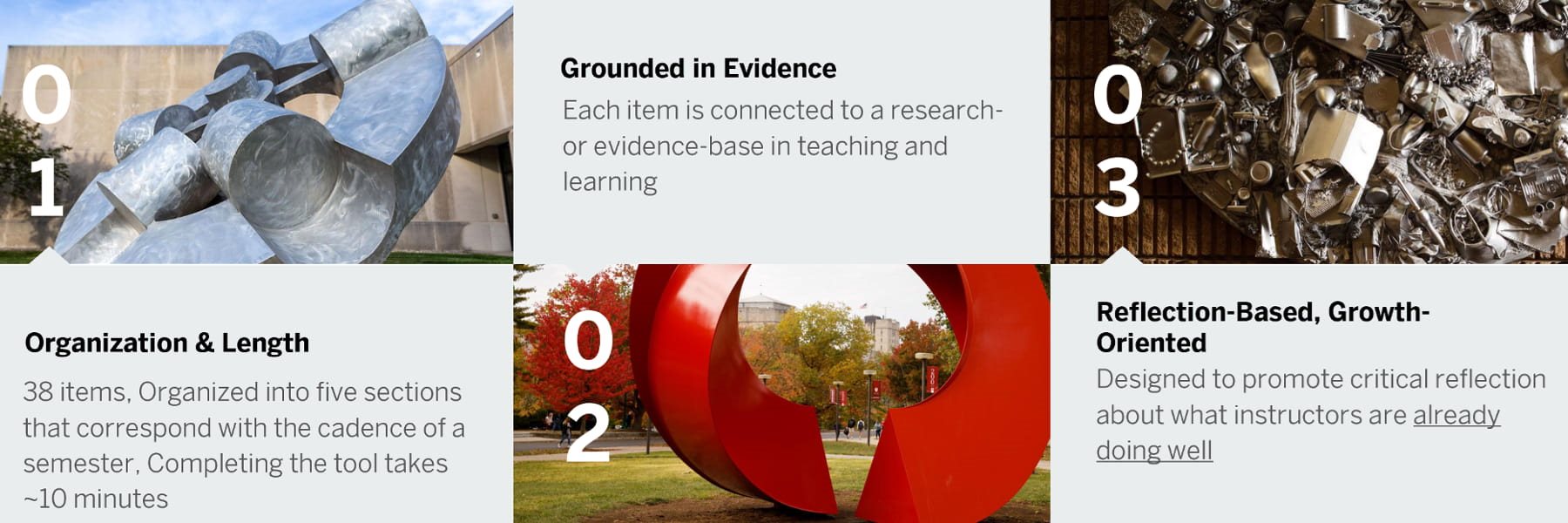
The culture of care is a self-assessment survey designed by educational developers at the IU Indianapolis Center for Teaching and Learning (CTL) with initial input from more than two hundred faculty members. It is a survey that is organized into five sections that correspond with the cadence of the semester. There are 38-Likert-style questions designed for college-level teachers to document current teaching practices and use as a reflective survey to consider new practices to try. Completing the survey takes approximately 10 minutes.
While adopting a standard of care is a common practice in the health professions, conversations about setting standards for teaching in higher education are rare and needed given the national focus on degree completion, patterns of isolation and mental health struggles among college students, and the persistent call to decrease opportunity gaps for underrepresented and underserved populations. This framework and critical self-reflection survey are built on the premise that relationships are key to student success and educators have an ethical responsibility to create a climate of care.
Scholarship in higher education, educational psychology, feminist philosophy, and race and resistance studies argues that building relationships is key for student success (Felten & Lambert, 2020), community-responsive education centers relationships, relevance, and responsibility as domains that build and sustain individual well-being of learners (Duncan-Andrade, 2022), and individual educators have an ethical responsibility to create a “climate of care” to promote student belongingness and success (Noddings, 1988).
The instrument was piloted in spring 2024 with a group of fifteen instructors from a range of disciplines who were optimistic about the potential of this approach. Since then, approximately six hundred instructors have completed the survey.
This IRB-approved research project is being conducted by the Center for Teaching and Learning at IU Indianapolis. The project PI is Marie Brown, Director, Center for Teaching and Learning. Project Co-PI’s are Anusha Rao, Assistant Director, Center for Teaching and Learning, and Christina Downey, Associate Vice Chancellor for Undergraduate Education.
Faculty and instructional staff who have completed the survey have reported the process of self-reflection to be illuminating. Some have expressed appreciation for the opportunity to reflect upon their teaching practices and to gain new ideas and insights for ongoing improvement. In one exit ticket, respondents were asked to “share 1-2 enhancements that you commit to incorporating into your teaching practice this semester.” Across the qualitative feedback gathered from 37 respondents, the following themes emerged: (1) instructors committed to gathering mid-semester feedback to build trust, improve instruction, and center student voices; (2) instructors sought to incorporate "letters to future students" or "how to succeed" notes to foster metacognitive reflection and offer peer-to-peer advice; and (3) instructors expressed intentions to enhance transparency, accessibility, and communication norms, especially through early course activities and clearly structured check-ins after major assignments or exams.
Regarding the survey itself, faculty have offered the following testimonials:
Culture of Care Teaching Survey ... made me reflect on my own practices and how to improve.
I liked the emphasis on caring for students, and how can they present in different ways.
Really liked the questionnaire that helped provide specificity of strategies and tactics.
I enjoyed the Culture of Care Teaching Survey, please continue this!
We want to see our students succeed and one way for that to happen is to make sure that we are constantly reflecting on our teaching practices and resurveying ourselves so that we can be better at our practice.
The Center for Teaching and Learning at IU Indianapolis is developing an accompanying “Culture of Care in Teaching” Canvas course which will be available to instructors soon. The course delves deeper into the framework and survey and promote critical reflection about current teaching practices while also validating instructors’ use of teaching practices that are evidence-based. The interactive course provides a framework, strategies, and resources to help instructors make small adjustments to that are likely to enhance the learning experience and promote student engagement and success. The Canvas course also features student and instructor scenarios and includes suggestions for applying the framework in a variety of teaching contexts.
For questions about this project, please contact Dr. Marie Brown, PI, at meb10@iu.edu.
Please contact the PI, Marie Brown, for more information about the research project, survey items, and attribution.
Center for Teaching and Learning social media channels